High gas prices and traffic jams trace straight back to the Boston Tea Party.
The Boston Tea Party demonstrated against a government-granted mercantile monopoly, triggering a war. The Framers forbade rebuilding that path to war. The Federal highway monopoly rebuilt it via foreign oil addiction: wars in Iraq, Afghanistan, and Iran, and war-driven gas prices at home.
1773 · 1787 · 1792 · 1817–1860 · 1916 · Today
The Federal-Aid Highway Acts of 1916, 1944, and 1956 established the federal mercantile monopoly resulting in:
These harms are reviewed below.
The Root Cause of these harms is federal violation of the Constitution in establishing the mercantile monopoly by the Federal-Aid Highway Acts of 1916, 1944, and 1956.
The Constitution is an enumerated powers document. Powers granted are limited to those explicitly granted.
Everything else — "internal improvements" — was reserved to the States and the people.
"The powers delegated by the proposed Constitution to the federal government are few and defined. Those which are to remain in the State governments are numerous and indefinite. The former will be exercised principally on external objects, as war, peace, negotiation, and foreign commerce; with which last the power of taxation will, for the most part, be connected. The powers reserved to the several States will extend to all the objects which, in the ordinary course of affairs, concern the lives, liberties, and properties of the people, and the internal order, improvement, and prosperity of the State."
The Tea Act of May 1773 granted the East India Company the right to ship its tea directly to the colonies and sell it through its own appointed consignees — a government-granted monopoly over the supply chain of a staple of colonial commerce, bypassing colonial merchants and shippers.
On December 16, 1773, Bostonians dumped 342 chests of the Company's tea into the harbor. Parliament answered with the Coercive Acts. Within two years, Americans were at war.
The Boston Tea Party was a demonstration against a general government's mercantile monopoly that triggered a war. Fourteen years later, the men who wrote the Constitution had not forgotten it.
Four days before the Convention adjourned, Dr. Franklin moved to expand the "post Roads" power. Madison moved to expand it further. Rufus King and George Mason named the danger: mercantile monopolies.
"Docr. FRANKLIN moved to add after the words "post roads" Art I. Sect. 8. "a power to provide for cutting canals where deemed necessary""
Madison moved to enlarge the motion into a power "to grant charters of incorporation where the interest of the U.S. might require & the legislative provisions of individual States may be incompetent." His object was "to secure an easy communication between the States." In Congress in 1792 and as President in 1817, Madison enforced the "post Roads" restriction in opposing and vetoing federal highways.
"The States will be prejudiced and divided into parties by it. In Philada. & New York, It will be referred to the establishment of a Bank, which has been a subject of contention in those Cities. In other places it will be referred to mercantile monopolies."
"Col: MASON was for limiting the power to the single case of Canals. He was afraid of monopolies of every sort, which he did not think were by any means already implied by the Constitution as supposed by Mr. Wilson."
Even limited to canals alone, the power was refused:
8 to 3. The incorporation power fell with it.
The Convention did not leave the question open. It was asked whether the Federal government should have power to build internal improvements, and it answered no. The only transportation power left standing was limited to delivering letters in defense of free speech, "post Roads."
Source: Madison's Notes, September 14, 1787 (Avalon Project, Yale Law School) · postRoads.com
Five years later, Representative James Madison opposed a bill paying bounties to the cod fisheries. His warning names the line exactly: post roads are Federal; every other road is not.
"those who ratified the constitution conceived, that this is not an indefinite government deriving its powers from the general terms prefixed to the specified powers—but, a limited government tied down to the specified powers, which explain and define the general terms."
"If Congress can apply money indefinitely to the general welfare, and are the sole and supreme judges of the general welfare, they may take the care of religion into their own hands; they may establish teachers in every state, county, and parish, and pay them out of the public treasury; they may take into their own hands the education of children, establishing in like manner schools throughout the union; they may assume the provision for the poor; they may undertake the regulation of all roads other than post roads; in short, every thing, from the highest object of state legislation, down to the most minute object of police, would be thrown under the power of Congress"
Courts cannot change the wording of the Constitution. Only an Amendment can. Article V is the only way to change the Constitution: two-thirds of both Houses of Congress, or a convention called by two-thirds of the States, propose; three-fourths of the States ratify. That governments will violate the Constitution is a certainty. A violation, even one blessed by a court, does not change a word of it.
The Framers wrote better than they could politic. The Declaration of Independence is Americans' definition of Liberty: "all men are created equal." The Constitution mandated its defense. Courts have failed that text in both directions — refusing to defend Liberty against State governments1, and granting the Federal government powers the Convention refused on September 14, 17872. As great a man as John Marshall was, in 1833 he used the Court to declare that the Federal government could not defend Liberty against State government violations. It took 600,000 dead soldiers and the Fourteenth Amendment (1868) to mandate that it must. Article V was never used to grant the Federal government power over internal improvements.
"No Preference shall be given by any Regulation of Commerce or Revenue to the Ports of one State over those of another"
Taxing the whole nation to build the facilities of commerce of favored places is a preference. Senator Henry Clay spent a career trying to fund roads in Kentucky with Federal money; President Jackson's Maysville Road veto stopped him.
When the Confederate States wrote their constitution in 1861, they made the limit explicit. It carries no legal weight — but it shows how the drafters of the time read the intent of the Framers:
"To regulate commerce with foreign nations, and among the several States, and with the Indian tribes; but neither this, nor any other clause contained in the Constitution, shall ever be construed to delegate the power to Congress to appropriate money for any internal improvement intended to facilitate commerce; except for the purpose of furnishing lights, beacons, and buoys, and other aids to navigation upon the coasts, and the improvement of harbors and the removing of obstructions in river navigation; in all which cases such duties shall be laid on the navigation facilitated thereby as may be necessary to pay the costs and expenses thereof."
For more than forty years, Presidents Madison, Monroe, Jackson, Tyler, Polk, Pierce, and Buchanan enforced the "post Roads" limit with veto messages against Federal taxing to build internal improvements.
"The legislative powers vested in Congress are specified and enumerated in the eighth section of the first article of the Constitution, and it does not appear that the power proposed to be exercised by the bill is among the enumerated powers…"
"I am of opinion that Congress do not possess this power; that the States individually can not grant it…"
"Although frequently and strenuously attempted, the power to this extent has never been exercised by the Government in a single instance. It does not, in my opinion, possess it; and no bill, therefore, which admits it can receive my official sanction."
"There can not, in fact, be drawn the slightest discrimination between the improving the streams of a State under the power to regulate commerce and the most extended system of internal improvements on land."
"The Constitution has not, in my judgment, conferred upon the Federal Government the power to construct works of internal improvement within the States, or to appropriate money from the Treasury for that purpose."
"It may be safely inferred that if the framers of the Constitution had intended to confer the power to make appropriations for the objects indicated, it would have been enumerated among the grants expressly made to Congress."
"It is certain that the power in question is not enumerated among the express grants to Congress contained in the instrument."
"What a vast field would the exercise of this power open for jobbing and corruption!"
Texts: The American Presidency Project, UC Santa Barbara. Pocket vetoes explained in annual messages are linked to those messages. Quotations are verbatim; … marks omitted text.
The Federal Aid Road Act of 1916 ignored the Convention, Madison, and 21 veto messages. Federal taxing to build roads began, and transportation became a Top-down Federal plan built around the 25 mpg efficiency of the Model-T.
What the monopoly replaced was working. In 1902, every US city over 10,000 people had one or more privately funded streetcar systems providing mobility as a service. The highway monopoly wiped them out.
In 1916, US railroads reached their peak of about 254,000 miles. Railroads move a ton about 470 miles per gallon (Warren Buffett on rail efficiency) — 188 times the efficiency of a car moving a 200-pound person at 25 mpg. The highway monopoly wiped out about 45% of those railroads.
The Federal-Aid Highway Act of 1956 scaled it. It was not a Left or Right project: Senator Albert Gore Sr. wrote it; President Eisenhower signed it. The Left wanted Federal spending; the Right wanted the oil-powered mercantile economy. Both used the same tax collectors, and both ignored the enumerated limit.
Within four years, Eisenhower saw what he had signed. In April 1960 his staff recorded his reaction to a report on the program:
"…the matter of running Interstate routes through the congested parts of the cities was entirely against his original concept and wishes; that he never anticipated that the program would turn out this way."
"In other words, the Yellow Book depicting routes in cities had sold the program to the Congress."
"He also observed that Public Works per se was considered one of the biggest ‘grabbags’ for Federal Funds…"
A century earlier, President Buchanan had warned what the power would open: "a vast field … for jobbing and corruption."
Two-thirds of the remaining Interstate funds — $17 billion — went to routes through cities (Eno Center for Transportation, 2020). The Interstates destroyed the commercial strength of walkable cities. City blocks walkable enough to score above about 70 on Walk Score can maintain their own infrastructure from sales and property taxes; below that, they cannot. Highways cut through those blocks and turned self-funding places into dependents on Federal transfers (WalkScore70.com).
Further reading: Jane Jacobs, The Death and Life of Great American Cities (1961) · Charles Marohn, Strong Towns (2019) · Jeff Speck, Walkable City (2012) · JPods.com/walkable · JPods.com/bikes
King warned the power would be "referred to mercantile monopolies." It was. The government that holds the war-power took up commercial self-interest — the same mixing the Boston Tea Party demonstrated against in 1773. A single Federal design — two tons of car to move one person — became mandatory for American cities. The 1975 Congressional study PB-244854, Automated Guideway Transit, found "institutional failures" had blocked transportation innovation for "four to six decades."
A mercantile monopoly is Federal control of the means of production: the war and police powers of government mixed with commerce. Three examples — mobility, labor, and energy. The highway and slavery monopolies led to war. The highway and coal monopolies led to climate change.
The highway monopoly created foreign oil addiction, and oil wars since 1990 to secure those supplies. Since the US military shifted from rail to trucks, its war record is 0 wins and 3 losses (DividedSovereignty.com).
The Fugitive Slave Acts of 1793 and 1850 put Federal police power behind the control of labor inputs into commerce — a mercantile monopoly on the employment of labor. The 1850 Act commanded citizens to assist in capture and denied the accused a jury.
It was Constitutional — Article IV, Section 2 enumerated it. That does not diminish that it was a mercantile monopoly. Northern states answered with personal liberty laws — nullification. South Carolina's 1860 Declaration of Causes cited that nullification as a cause of secession. Illicit Energy built the path to the Civil War, at the cost of 600,000 American soldiers.
The Rural Electrification Act of 1936 favored centralized, coal-burning power monopolies. It wiped out a Bottom-up wind industry that was making 80,000 windmills a year; about 600,000 windmills were abandoned.
Renewables are recovering only now, Bottom-up: wind supplies 62% of electricity in Iowa, 34% in Oklahoma, 24% in Texas.
Climate Change Root Cause, 2023
Since the US military shifted from rail to trucks: Vietnam, Iraq, and Afghanistan. Oil-dollars funded the 9/11 terror attacks that opened the war in Afghanistan. It is a half-truth that the US won in Iraq: Iraq is not a reliable ally today.
"Oil-dollars fund friends, enemies, and terrorists alike. We borrow the funds to buy that oil and defend access to it with debt, thereby mortgaging the future labor of children."
Oil may not have triggered Vietnam directly. But in all three wars the US built allied defenses powered by oil. When US forces withdrew, they withdrew the subsidized oil required to power those defenses — and the defenses failed. Had railroads or podcar networks been built, the energy required to provide security would have been sustainable by the local allies.
Turning enemies into not-enemies. Wars end when former enemies have a stake in the peace. Reconstruction after the Civil War and the Marshall Plan after World War II are examples of this principle in action.
Documenting expectations, then repeatedly and regularly assessing outcomes against them to adapt. This agile approach dominates manufacturing and military competition alike. Field Marshal Helmuth von Moltke famously said, "No plan of operations reaches with any certainty beyond the first encounter with the enemy's main force." General Eisenhower: "Plans are worthless, but planning is everything."
A principle of war in the United Kingdom's doctrine — and mandated by the US Constitution, which charges the Federal government and Army to secure the Blessings of Liberty to ourselves and our Posterity.
The US Principles of War lack all three. That failure accounts for the thinking behind the recent 0 and 3 win-loss record of the US Army.
Only a fool pees in his only well. Duty mandates we defend Liberty for Posterity. Federal central planning and mercantile monopolies in energy and transportation drive warming and insecurity. For those who reject climate science for political reasons, skip this section and just consider wars in Iraq, Afghanistan, and Iran, and $40 trillion in federal debt.
NASA's Goddard Institute ranked the climate impact of 13 economic sectors. The first and the future largest drivers of warming are the two sectors Federal monopolies built: highways and centralized power.
"In their analysis, motor vehicles emerged as the greatest contributor to atmospheric warming now and in the near term. Cars, buses, and trucks release pollutants and greenhouse gases that promote warming, while emitting few aerosols that counteract it."
"By 2050, electric power generation overtakes road transportation as the biggest promoter of warming."
"Targeting on-road transportation is a win-win-win. It's good for the climate in the short term and long term, and it's good for our health."
Oil wars, oil-dollar-funded terrorist attacks, and $40 trillion in Federal debt resulted from the failure to answer calls to action to end foreign oil addiction by ten Presidents. Not every one named it a threat to national security. Every one named the dependence — and oil wars have been real since 1990.
"At the end of this decade, in the year 1980, the United States will not be dependent on any other country for the energy we need to provide our jobs, to heat our homes, and to keep our transportation moving."
President Nixon is the only President to act on highways, sending his daughter to open the Morgantown PRT in 1972 to demonstrate an alternative to highways. Congressional study PB-244854, "Automated Guideway Transit", initiated in 1974 to find solutions to traffic and the hardships of the 1973 Oil Embargo, identified such guideways as a way to reduce "consumption of petroleum-derived fuels."
"First, we must reduce oil imports by 1 million barrels per day by the end of this year and by 2 million barrels per day by the end of 1977. Second, we must end vulnerability to economic disruption by foreign suppliers by 1985."
"This intolerable dependence on foreign oil threatens our economic independence and the very security of our Nation. The energy crisis is real. It is worldwide. It is a clear and present danger to our Nation. These are facts and we simply must face them."
"And I think the best answer, while conservation is worthy in itself, is to try to make us independent of outside sources to the greatest extent possible for our energy…"
"Our country now imports nearly half the oil it consumes and could face a major threat to its economic independence."
"I am today concurring with the Department of Commerce's finding that the Nation's growing reliance on imports of crude oil and refined petroleum products threaten the Nation's security because they increase U.S. vulnerability to oil supply interruptions."
"Keeping America competitive requires affordable energy. And here we have a serious problem: America is addicted to oil, which is often imported from unstable parts of the world."
"America's dependence on oil is one of the most serious threats that our Nation has faced. It bankrolls dictators, pays for nuclear proliferation, and funds both sides of our struggle against terrorism."
"We will become, and stay, totally independent of any need to import energy from the OPEC cartel or any nations hostile to our interests."
"Second, this crisis is a stark reminder: To protect our economy over the long term, we need to become energy independent. I’ve had numerous conversations over the last three months with our European friends of how they have to wean themselves off of Russia — Russian oil. It’s just not — it’s just not tenable. It should motivate us to accelerate the transition to clean energy."
Net petroleum imports as a share of petroleum products supplied, by year of the statement: US Energy Information Administration, Monthly Energy Review, Table 3.3a. A net exporter still imports: refineries run on imported crude, and the price of oil — and the wars over it — are set worldwide.
The Framers divided sovereignty: the Federal government may tax for warfare, not welfare; the States may tax for welfare, not warfare. Federal mixing of war-power with commercial self-interest rebuilt known paths to war — taxation without representation, illicit energy, and transferring wealth from the Many to the Few — and created two civilization killers: oil famine and climate change.
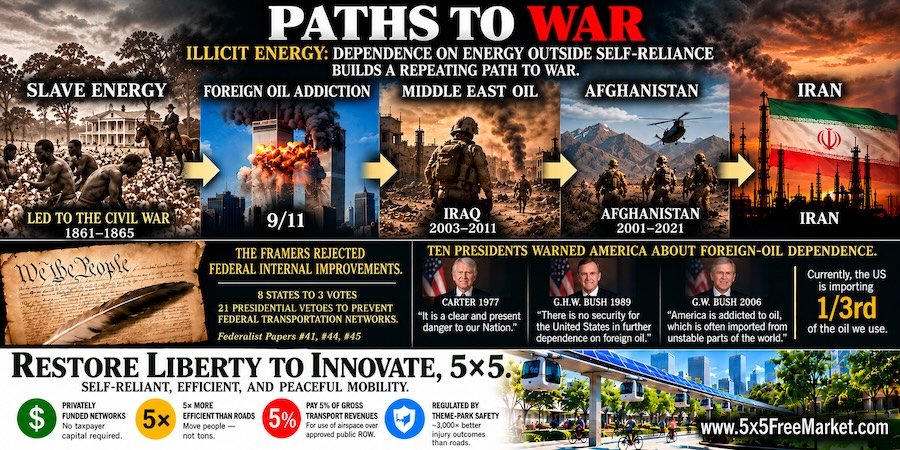
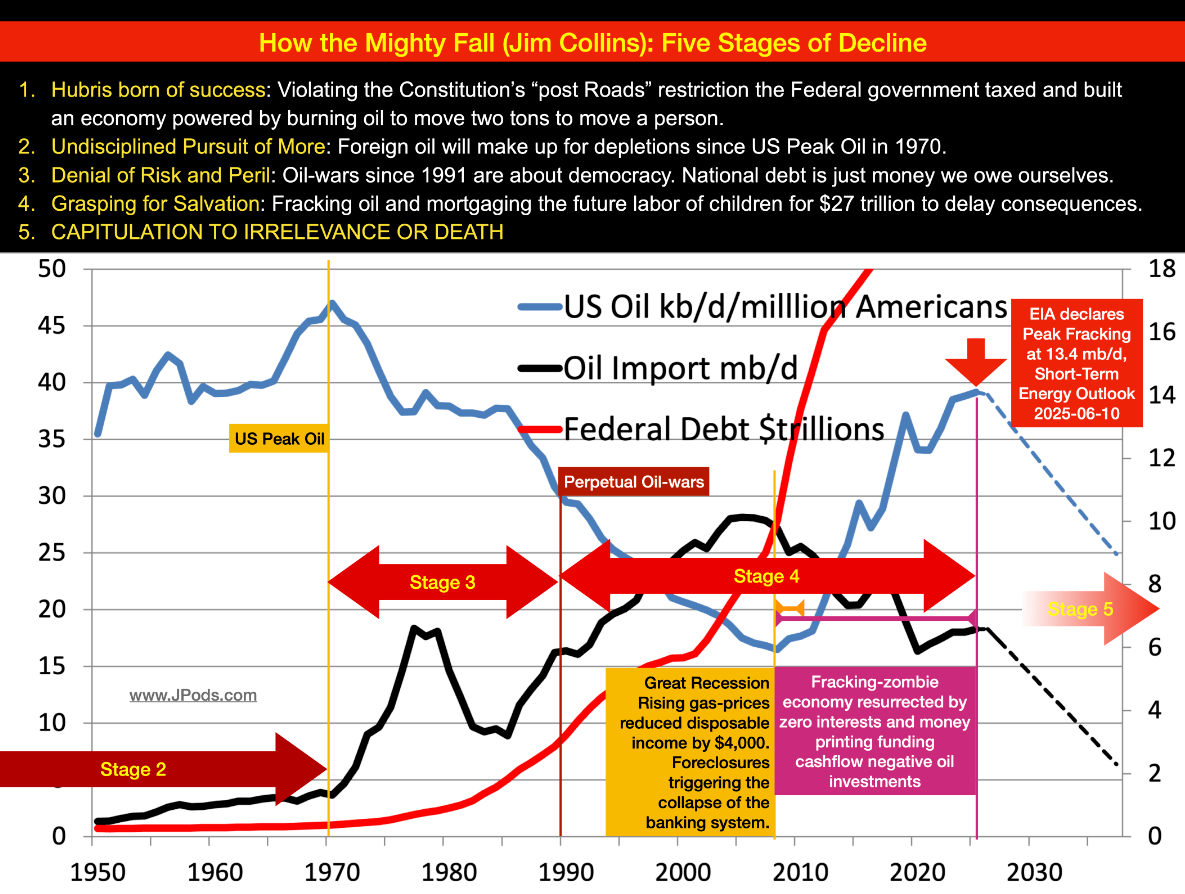
US Peak Oil was 1970. A highway network that burns energy moving two tons to move a person bound the economy to foreign oil. Ten Presidents, Nixon through Biden, called for an end to foreign oil dependence; none was answered.
Iraq invaded Kuwait in 1990; Desert Storm followed in 1991. Since 1990, American soldiers have traded blood to buy time in oil wars. The dollar cost of the Iraq and Afghanistan wars: about $8 trillion.
Climate Change Root Cause, 2023
Federal debt rose in tandem with oil imports after US Peak Oil in 1970 and now approaches $40 trillion (US Treasury, Debt to the Penny). Defense spending since 1990 exceeds $20 trillion.
Debt kept rising after 2005, even as oil imports fell. Government money printing radically changed twice — after the 2007–09 financial crisis and again with COVID — and debt increased with money printing. The Dallas Fed estimated the crisis cost $6 to $14 trillion — "the equivalent of $50,000 to $120,000 for every U.S. household" (Dallas Fed, July 29, 2013). How oil imports, oil wars, and money printing combine to drive the debt is open for review by economists — bill.james@jpods.com.
The 16th and 17th Amendments enabled Federal taxing for welfare as well as warfare, but neither enumerated a permission to tax for welfare. The 18th Amendment did empower Federal policing of personal commerce — and the 21st repealed it.
Debt beyond 19 years is a tax on the future labor of children imposed without their consent — taxation without representation, again.
"…nor the nation itself can validly contract more debt, than they may pay within their own age, or within the term of 19 years." — Jefferson to Madison, September 6, 1789
NASA: "Road Transportation Emerges as Key Driver of Warming" (2010). Burning energy moving two tons to move a person is the Climate Change Root Cause.
Freight railroads move a ton about 470 miles per gallon. Federal highways move a person at about 25.
Climate Change Root Cause, 2023
"In the general course of human nature, A POWER OVER A MAN's SUBSISTENCE AMOUNTS TO A POWER OVER HIS WILL."
By definition, excellence does not comply. Uniform Federal highway policy made city streets unsafe for children, unwalkable, jammed with traffic, and economically crippled — everywhere at once.
Diversity of State economies is how a republic finds what works. It was the diversity of State economies that forced an end to Federal support for slavery. We need the same diversity now, so that States and cities can adapt to locally sustainable energy and transport. Each place that tries something different produces evidence the others can learn from. One Federal standard produces one result and nothing to compare it with.
"…the way to have good and safe government, is not to trust it all to one, but to divide it among the many, distributing to every one exactly the functions he is competent to. Let the national government be entrusted with the defence of the nation, and its foreign and federal relations; the State governments with the civil rights, laws, police, and administration of what concerns the State generally; the counties with the local concerns of the counties, and each ward direct the interests within itself. It is by dividing and subdividing these republics from the great national one down through all its subordinations, until it ends in the administration of every man's farm by himself; by placing under every one what his own eye may superintend, that all will be done for the best. What has destroyed liberty and the rights of man in every government which has ever existed under the sun? The generalizing and concentrating all cares and power into one body…"
The Federalist made the same case. Divided, a failure in one State is contained and corrected by the others. Made uniform, a failure spreads to all of them at once — as the highway monopoly did.
"Should abuses creep into one part, they are reformed by those that remain sound."
"The influence of factious leaders may kindle a flame within their particular States, but will be unable to spread a general conflagration through the other States."
"A rage for paper money, for an abolition of debts, for an equal division of property, or for any other improper or wicked project, will be less apt to pervade the whole body of the Union than a particular member of it; in the same proportion as such a malady is more likely to taint a particular county or district, than an entire State."
States are sovereign over "internal improvements." Reportedly 34 State Constitutions forbid monopolies. Those provisions are the law of those States today — no Federal permission is needed to honor them.
| State | Constitution |
|---|---|
| Arkansas | Art. 2, §19: "Perpetuities and monopolies are contrary to the genius of a republic, and shall not be allowed; nor shall any hereditary emoluments, privileges or honors ever be granted or conferred in this State." |
| Arizona | Art. 2, §15: "Monopolies and trusts shall never be allowed in this state…" including any combination to "regulate the transportation of any product or commodity." |
| Georgia | Art. I, Sec. VI, Para. V: the General Assembly "shall not have the power to authorize any contract or agreement which may have the effect of or which is intended to have the effect of encouraging a monopoly, which is hereby declared to be unlawful and void." |
| Maryland | Declaration of Rights, Art. 41: "That monopolies are odious, contrary to the spirit of a free government and the principles of commerce, and ought not to be suffered." |
| Massachusetts | Art. 6: "No man, nor corporation, or association of men, have any other title to obtain advantages, or particular and exclusive privileges…" |
| North Carolina | Art. 1, §34: "Perpetuities and monopolies are contrary to the genius of a free state and shall not be allowed." |
| Oklahoma | Art. II, §32: "Perpetuities and monopolies are contrary to the genius of a free government, and shall never be allowed, nor shall the law of primogeniture or entailments ever be in force in this State." |
| Texas | Art. 1, §26: "Perpetuities and monopolies are contrary to the genius of a free government, and shall never be allowed, nor shall the law of primogeniture or entailments ever be in force in this State." |
| Utah | Art. XII, §20: "It is the policy of the state of Utah that a free market system shall govern trade and commerce in this state to promote the dispersion of economic and political power and the general welfare of all the people." |
| Wyoming | Art. 1, §30: "Perpetuities and monopolies are contrary to the genius of a free state, and shall not be allowed. Corporations being creatures of the state, endowed for the public good with a portion of its sovereign powers, must be subject to its control." |
Other States forbid monopolies by statute — South Carolina §39-3-10 declares void any combination that may "lessen or affect in any manner the full and free competition in any tariff, rates, tolls, premium or prices in any branch of trade, business or commerce."
The path has been walked before. A 1918 Federal communications monopoly held back the technologies of the Internet for most of a century. In 1982 the courts restored free markets, and the Internet followed. Transportation can be restored the same way — Bottom-up, State by State, city by city.
Cities and States, sovereign over internal improvements, grant rights-of-way to transportation networks that:
"What prudent merchant will hazard his fortunes in any new branch of commerce when he knows not but that his plans may be rendered unlawful before they can be executed?"
Solar-powered, grade-separated networks such as JPods cut oil use, end the dependence that drives oil wars, and convert traffic costs into local profits instead of Federal debt. The full argument: Climate Change Root Cause: Unconstitutional Federal Highways Making Unwalkable Cities.